THE UNIQUE SHIRTS WORN BY THE WORLD’S BEST FOOTBALL LEAGUES ARE NOT ONLY BEAUTIFUL OBJECTS, BUT ONES FILLED ALSO WITH SPECIFIC SYMBOLISM. A NEW BOOK TELLS US HOW TO READ—AND CHEER FOR—EVERY TEAM.
BY DAVID MASELLO
Just as people often wave their nation’s flag in pride, so, too, do many football players take off their shirts after a game and wave it in the air before handing it to members of the opposing team, or to ardent fans begging for that sweat-soaked garment. It’s a longstanding custom.
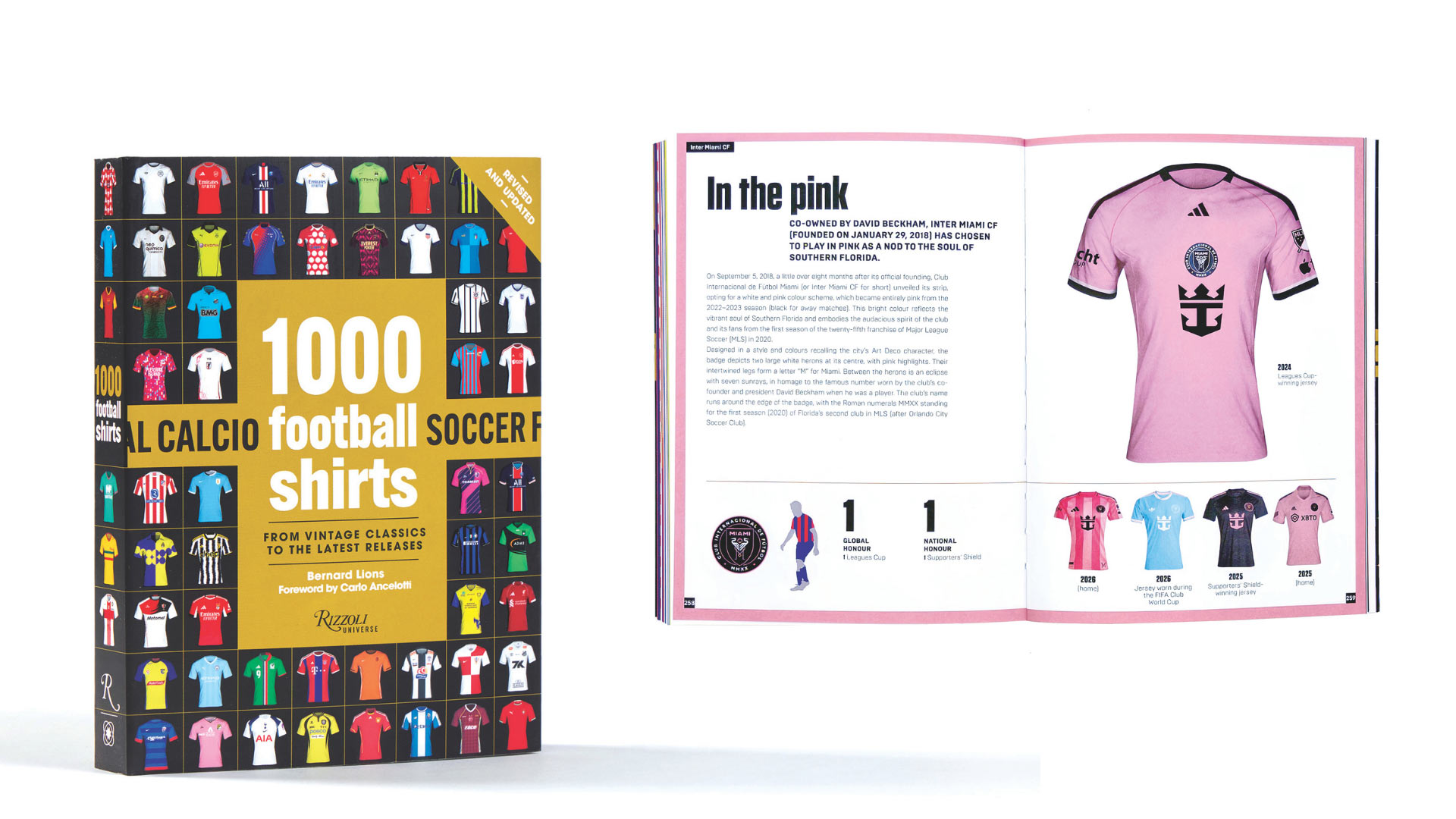
The colors, the symbols, the numbers, and even the lengths of sleeves possess symbolic import on every team’s shirt. Shirts do so much more than tell the history of football,” writes Bernard Lions in his newly revised edition of 1000 Football Shirts: From Vintage Classics to the Latest Releases (Rizzoli). “They stand for entire eras, stoking memories and dreams of impossible matches and unforgettable teams,” adds Lions, a star player in the arena of French sports journalism.
Indeed, there is no sport with a greater sense of ritual and symbolism than football (a.k.a., soccer, here, of course)—and the occasional rowdiness. So much of the identity of a team, a nation, and its star players is embodied by the shirt they wear on that green playing field.
For 90 minutes, 22 men (and women, in their equally thrilling leagues) run up and down a playing field that measures some 110-120 yards long and 70-80 yards wide—which is what will be happening this summer as Miami hosts the 2026 FIFA World Cup (June 15–July 18). And while watching the teammates dribble the ball between them on their way to making goals is a thrilling spectacle of physical prowess, it’s the sheer sights of their uniforms, too, that add a dimension to the sport unlike any other. Of the actual shirt, Carlo Ancelotti, the current manager of the Brazil national team and a former star player for numerous teams, including Parma, Rome, and AC Milan, can still recall the feel of the garment. “Made from a heavy fabric, the shirt was so hot that it overwhelmed me in the winter and in the summer risked hospitalizing me for suffocation, yet it was my formula for happiness,” he writes in the foreword to the book. While a team’s win is certainly a formula for a fan’s happiness, for many, simply witnessing their talented team players wearing their shirt provides its own form of joy.
Come summer, there will be plenty of fans of many opposing teams crowding the stands at Miami’s Hard Rock Stadium, with eight decisive matches planned. But the shirts worn by Club Futbol (also known as Inter Miami CF), a team co-owned by living legend David Beckham, will have an almost Technicolor effect in the stadium. As described by Lions, the bright pink of the Miami garment “reflects the vibrant soul of Southern Florida and embodies the audacious spirit of the club and its fans.” The very lettering, the depiction of two herons, and the precise striping and lines harken, too, he points out, to Miami’s Art Deco character.
And like every team’s shirt, Miami’s assumes different looks and color combinations when its players are competing in other cities. Unlike American football, baseball, basketball, or hockey, the shirts of football players assume different identities at different locales, although the symbolism on them remains the same.
Lions’ book is arranged team by team, with practically a thread-by-thread look at the shirts and every element stitched and printed on them, coupled with a profile of star players from each league. No shirt design or color scheme is accidental. For Brazil’s Seleção Canarinho (Canary Squad), for instance, the green symbolizes the forests of the Amazon, while the golden yellow represents the actual gold reserves of the nation. The black crow that appears to fly on the Japanese shirt is a figure representing the love of family, overall good luck, and the kind of virtues embodied by the ancient samurai warriors. So charged are the shirts with symbolism and superstition that France’s Les Bleus team shifted their crest emblem from looking out to looking into the very heart of the player. “With their emblems looking them straight in the hearts again, Les Bleus were finalists on home soil in Euro 106, before winning a second World Cup in 2018,” Lions recounts.
This book, which is really about the sport of the shirt, enables us to fully “read” every garment, revealing, for instance, that a star signifies a World Cup victory, that the number 13 isn’t an unlucky one in the sport, and that many a shirt winds up housed behind glass as a work of art. While the shirts are, indeed, fashionable and practical works of art, watching team players play is another kind of art, always worth watching.